It was 2014 and the Wall Street Journal ran an article titled The Web Is Dying; Apps Are Killing It. Back then, it was apps putting the web at risk; today, it is apps that (perhaps) have their days numbered: that is the cycle of technology.
Because something is actually changing. AI agents are starting to do things for us, while Generative UI promises interfaces built in real-time around our needs. What if this very combination is what changes the way we use and design the web?

We started with this question for a joint lecture with young designer Chiara Pizzo, a former student of the Scuola Italiana Design (SID), who wrote her thesis on the subject. It was an opportunity to explore the digital transformations currently underway and their potential impact on the real world with the second-year class of the SID Multimedia Design course.
In recent months, there has been increasing talk about AI agents. From OpenAI's Dots to Google's Gemini Agent, as well as Anthropic's Claude Cowork, Meta's Muse, and X's Grok Bot: these are tools that do not just answer questions, but can perform tasks, use applications, and interact with external services.
Meanwhile, almost quietly, another interesting dynamic is taking shape: Generative UI, which is the ability to generate interfaces in real-time based on user requests.
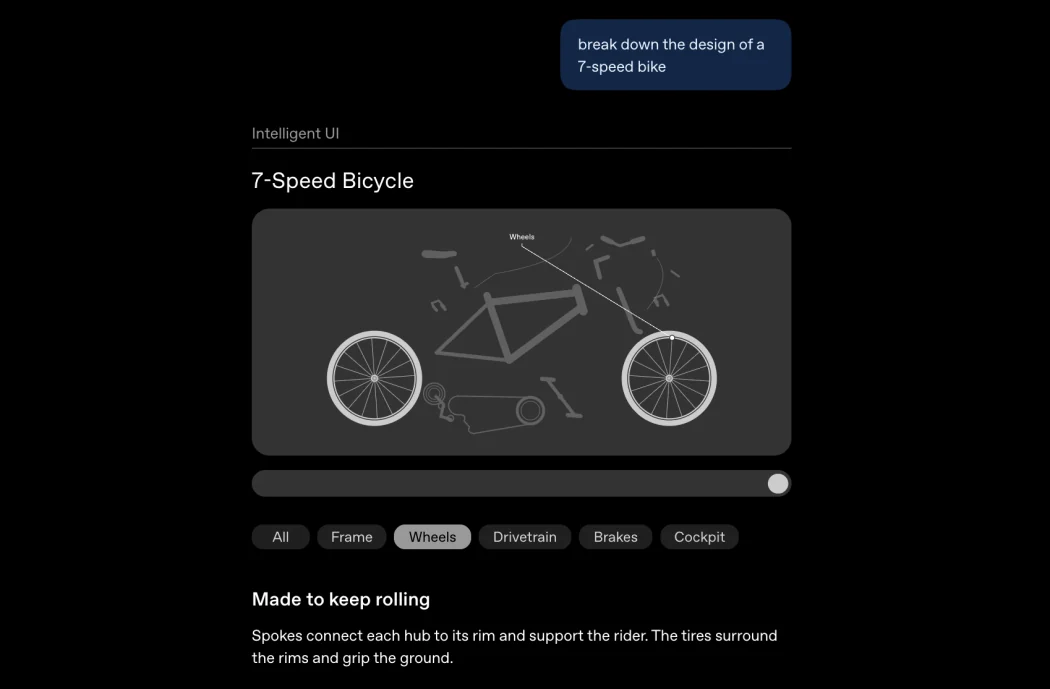
Google had already shown its potential in November 2025 with Gemini. More recently, on October 7, 2026, OpenAI introduced its Intelligent UI in ChatGPT, capable of combining text, visual elements, and interactive components based on the request.
When we wrote a few months ago about how GenUI could change the future of smartphones, we hadn't fully considered how much this technology could intertwine with the development of agents.
And perhaps that is exactly where the most interesting change lies.
Let's start with a concrete example, a task we are all familiar with: booking a train. Today, to do this, you have to: open an app > enter departure and arrival stations > choose dates > compare times > check fares > select a seat > complete the payment.
And then, we usually repeat all these steps on another platform to find the best deal.
These are steps we know so well that we consider them second nature. But why do we have to perform them all ourselves? With AI agents, we can think differently.
Instead of telling the software every single step, we can communicate the result we want to achieve directly.
"Find me a train to Milan for Friday morning. I'd like to arrive before 10 AM, spend less than 50 euros, and preferably travel without transfers."
At this point, the agent takes over to search for solutions, compare them, and prepare a proposal for us.
This doesn't necessarily mean eliminating every interaction; it means changing the starting point: no longer a sequence of commands to execute, but a goal to achieve.

This is where Generative UI comes into play.
An agent can perform a task on our behalf, but we still need to understand what it is doing, evaluate alternatives, adjust certain choices, and, above all, maintain control over important decisions.
Returning to the train example, receiving a simple text response with three options isn't enough: we need to compare times, prices, duration, and transfers through an interactive screen, with the freedom to change preferences without having to start from scratch every time.
And that is exactly the kind of experience that GenUI promises to make possible.
Instead of using an interface designed in advance for everyone, the system builds one tailored to our request, at that exact moment.
It’s not just about customizing colors or content, but about changing the structure, components, and interaction methods based on the need.
The first experiments in this direction are already a reality.
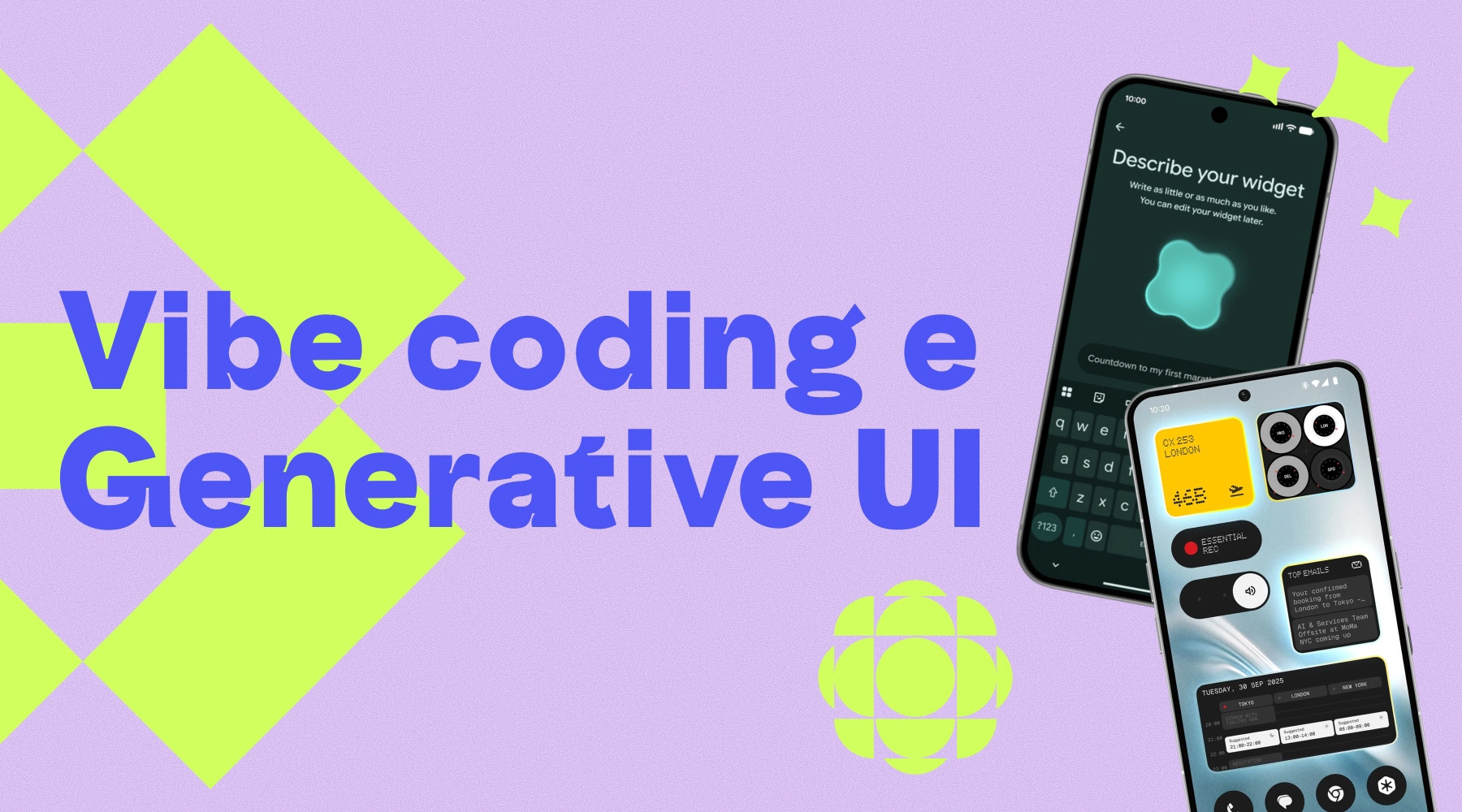
With Nothing Playground, for example, you can create small, custom widgets simply by describing what you want to achieve. We no longer have to limit ourselves to choosing from available features; we can build new ones, adapting them to our needs.
Google, with its research on Generative UI, has explored an even more interesting approach. Instead of generating a single element, Gemini can build entire interactive experiences in response to a request. We can ask it to explain a scientific phenomenon, organize an event, or compare information, and get a different interface every time.
A similar approach is that of OpenAI with Intelligent UI. The output received changes based on what we ask for: an interactive table to compare products, a simulation to understand a physical phenomenon, or a map with milestones and planning tools to organize a trip.
The difference is that we no longer need to adapt our query to the way a predefined interface works; it is the interface that adapts to the query.
But we can imagine taking this even further.
What if we no longer needed a different app for every task?
This is the direction that Rabbit attempted to explore with rabbitOS, an operating system designed around the concept of an agent, where you can create tools, experiences, and modify the system UI through natural language requests.
Rabbit was certainly a flop and didn't live up to its promises (we talked about it here) but the approach is interesting: imagine a digital environment where you don't have to choose which app to open, because the system is able to understand what you want to do, identify the necessary tools, and build the interface for you to interact with.
In this scenario, GenUI is no longer an additional feature, but becomes part of the very way we use technology.
Let's take another practical example: buying a pair of shoes.
Today, we open Google, Amazon, Foot Locker, or other e-commerce sites and search for the product, apply filters, compare prices, availability, reviews, and shipping costs. Then, finally, we complete the purchase.
Tomorrow, it will be enough to say:
"I'm looking for a pair of Nike running shoes, size 43, under 150 euros. I prefer something lightweight but with good cushioning."
An agent will query various stores, compare products and availability, read the information, and prepare a selection.
Generative UI will show us all of this through a purpose-built interface, allowing us to compare models and adjust our preferences.
And once the shoe is chosen? We will authorize the agent to complete the purchase. All this without ever having visited the store's website.
Mind you, this doesn't mean e-commerce will disappear. Products, catalogs, warehouses, payments, logistics, support, and digital infrastructure will continue to exist, but websites might stop being the primary point of access to these services.
If this were to happen, it would change much more than just the way we shop.
The Amazon-Muse case is interesting for this very reason.
In September 2026, Amazon blocked purchases made through Muse, Meta's AI agent, claiming that access had not been authorized and raising issues related to transparency and security.
Beyond the specific reasons, the case highlights a tension that is likely to grow.
Companies invest enormous resources to bring people to their platforms: they design purchasing paths, recommendation systems, campaigns, promotions, and experiences intended to increase conversions and loyalty.
But what happens when an agent chooses which products to show and where to buy them? Who decides the order of the results? Which brands become visible? How much does a website's experience still matter if the user doesn't visit it?
It is not just a technological issue, but one of business models and control over the relationship with people.
And it is not a given that all the actors involved have an interest in favoring this change.
If interfaces are generated in real-time, the question naturally arises: what is left to design? In reality, a great deal. However, the type of work might change.
Today, we primarily design experiences through structures and paths defined in advance; we design screens, components, navigation, and flows, trying to anticipate user needs and behaviors.
In a generative system, however, you cannot predict every screen that will be shown; consequently, our task will be to define the rules to generate it correctly. Information hierarchies, behaviors, accessibility, consistency, feedback modes, error management, and levels of autonomy will become even more important.
And above all, we will have to ask ourselves when to grant autonomy to AI and when to return control to the human.
Because not everything can be delegated. As convenient as it may be, an interface generated in real time also risks being unpredictable, inconsistent, or difficult to understand. And in certain contexts, such as professional or high-stakes environments, predictability will remain fundamental.
Our work will thus shift from designing fixed solutions to creating systems capable of producing diverse solutions.
Many interfaces do not fully comply with the WCAG guidelines. According to the WebAIM Million Report 202695.9% of the homepages analyzed contain automatically detectable accessibility errors.
GenUI could help change this: if interfaces are generated from properly designed components and accessibility rules, we can achieve experiences that are more consistent with standards, rather than having to face the same problems every time.
But there is an even more interesting opportunity: designing not just interfaces that are accessible to everyone, but interfaces capable of adapting to each person's needs. A system that simplifies information, modifies content presentation, or proposes different interaction modes based on the individual's requirements.
It is precisely from this reflection that Chiara Pizzo's thesis was born, exploring the potential of Generative UI to make digital experiences more accessible and adaptable to diverse user needs.
Generating an interface with AI does not automatically make it accessible; rules, testing, and design responsibility will still be required. However, it would be reductive to consider this evolution merely as a way to save time or a few clicks.
This could also be an opportunity (not to be wasted) to make the digital world more inclusive.
We won't suddenly stop using apps and websites.
There will be tasks for which it will continue to make sense to interact directly with software, freely explore a catalog, or use specialized tools.
The future will likely not consist solely of conversations with AI assistants either. Voice and text are excellent for expressing an intent, but they are not always the best way to compare, understand, or manipulate information.
It is more likely that we will see a coexistence of traditional interactions, autonomous agents, and generative interfaces, with different balances depending on the context.
The interesting thing is that, after decades spent learning how software works, we are entering a phase where software will increasingly adapt to the way we want to use it.
And so, perhaps the right question is no longer whether apps will die, but whether, in a few years, we will still need to know which apps to use to do what we want.
So, long live apps!

Continue reading our blogs